Close your eyes for a moment. Picture a mother waking up at four in the morning. Not to cook, not to pray but to walk. She carries an empty pot on her head and sets off into the dark. The nearest water source is almost an hour away. By the time she gets back, her children are already late for school.
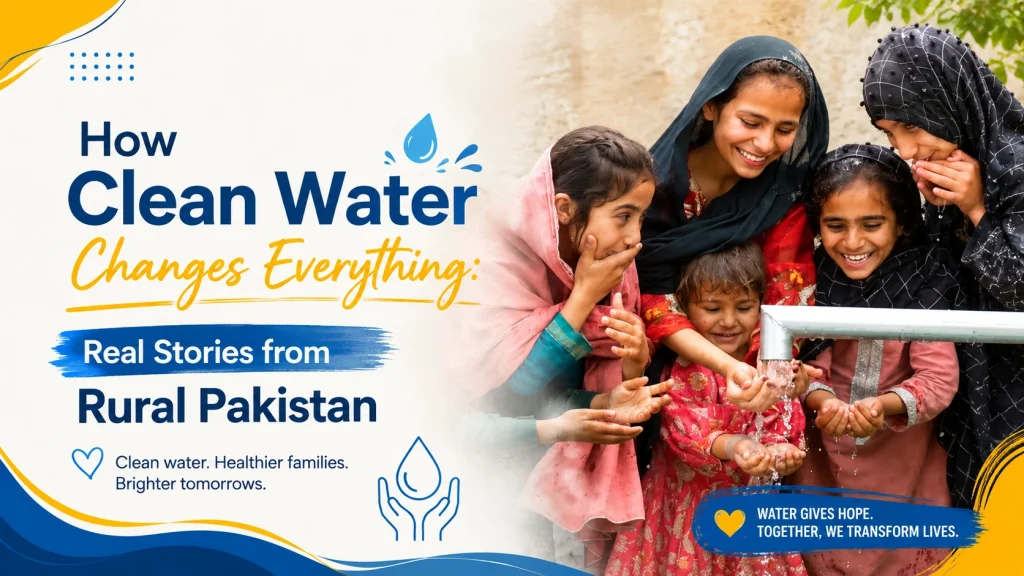
This is not a rare story. This is a Tuesday morning for thousands of families across rural Pakistan.
The good news is it does not have to stay this way. When clean water comes to a village, everything changes. Not slowly. Fast.
What the Water Crisis in Pakistan Really Looks Like
The water crisis in Pakistan is not just about thirst. It is about time, health, education, and dignity — all lost at once.
In the remote districts of Khyber Pakhtunkhwa, Azad Kashmir, South Punjab, and Balochistan, families depend on open streams, shallow pits, and seasonal rainfall. The water is often cloudy, smells bad, and carries illness. But families drink it because there is no other choice.
Women and girls carry the heaviest load. When a girl spends her morning collecting water, she cannot spend it in school. When a mother is sick from waterborne illness, she cannot care for her children. When a farmer uses contaminated water on his crops, he cannot feed his family.
The water crisis is also a poverty trap. It holds entire communities back not because of a lack of will, but because of a lack of a clean tap.
What Actually Changes When Clean Water Arrives
Help In Need has been running WASH (Water, Sanitation & Hygiene) projects across Pakistan since 2003. Our field teams have seen the same pattern repeat across dozens of villages and it never gets old.
Watch what our team witnessed on the ground when a new water well was installed:
📹 Watch the moment clean water reaches a village in Pakistan →
Here is what changes and why it matters.
Girls Go Back to School
In one village in Azad Kashmir, a primary school had been closed for two years. There was no water. Teachers could not run a school without it, and parents would not send their children to one. When Help In Need installed a pump, the school reopened within weeks. Girls returned first.
A clean water point does not just quench thirst. It gives children back their mornings.
Mothers Stop Fearing Their Own Water
In Toor Talha, Lakki Marwat one of the villages where we installed a solar-powered water well in partnership with Muslim Global Relief a mother told our field worker something simple and heartbreaking. She said that for fifteen years, every time she gave her children a glass of water, she prayed silently that it would not make them sick.
After the well was installed, she stopped praying that prayer. She finally knew the water was safe.
Farmers Start Growing Again
In South Punjab, a smallholder farmer had been using saline, contaminated groundwater on his wheat crop for years. His harvests were small and unpredictable. After a deeper, cleaner tube well was installed nearby, his harvest improved significantly in the very first season.
When water is safe and accessible, it does not just save lives. It rebuilds livelihoods.
How Help In Need Brings Safe Drinking Water to Rural Communities
Donating to a clean water project in Pakistan through Help In Need is not just sending money into the unknown. It is funding a system that is designed, built, and maintained to last for decades.
Step 1 — Finding the Families Who Need It Most
Before any project starts, our teams go to the community. They walk the routes women walk to collect water. They speak to mothers about their daily routines. They test the existing water sources. The villages with the highest need get first priority.
Step 2 — Building Something That Lasts
Help In Need uses high-quality materials and trained engineers on every project. In areas without electricity — which is most of the places we work — solar-powered water wells are the best solution. They run without fuel, require very little maintenance, and can provide safe drinking water for twenty years or more.
Step 3 — Handing It Over to the Community
Every water project includes a trained local water committee. A small group of villagers usually three to five people are taught how to maintain the pump, check water quality, and manage minor repairs. This is the step that turns a one-time installation into a permanent community resource.
Why a Water Well Is One of the Most Powerful Forms of Sadaqah Jariyah
The Prophet ﷺ said: “The best charity is giving water.”
Sadaqah Jariyah ongoing charity means a good deed whose reward continues flowing even after a person has passed away. A water well is perhaps the clearest example of this in practice.
Every family that drinks from the well earns you reward. Every child who grows up healthy because of clean water earns you reward. Every prayer performed with water from that well earns you reward long after you are gone.
Many of our donors choose to build a water well in the name of a parent or loved one who has passed away, as a form of Isaale-Sawab. It is one of the most meaningful ways to honour someone’s memory while helping a family you may never meet.
Find out more about giving Sadaqah Jariyah through Help In Need.
The Connection Between Water, Health, and Everything Else
Clean water does not fix just one problem. It unlocks a chain of improvements that touches every part of a family’s life.
When safe drinking water arrives in a village:
- Children get sick less often, which means they miss less school
- Mothers have more time and energy, which opens the door to work and education
- Families spend less on medicine and treatment money that can go toward food and children’s needs
- Crops grow better when irrigation water is clean
- The whole community becomes stronger, more self-reliant, and more able to plan for the future
This is why WASH sits at the centre of Help In Need’s humanitarian work in Pakistan. It is not one programme among many. It is the foundation that makes every other programme possible.
To understand how water connects to healthcare, read our piece on how Help In Need supports healthcare in underserved communities.
Where Our Water Projects Are Active Right Now
Help In Need’s clean water projects in Pakistan are active in some of the country’s most water-stressed regions:
Khyber Pakhtunkhwa (KPK) Upper Dir, Lakki Marwat, Mardan, and surrounding rural districts — areas where groundwater is deep and clean sources are scarce.
Azad Jammu & Kashmir (AJK) District Bagh, Dhirkot, Jhelum Valley, and Rawalakot — mountain communities where seasonal streams are the only option for most families.
South Punjab Bahawalpur and Dera Ghazi Khan — vast agricultural areas where saline groundwater is a daily challenge for farming families.
Balochistan Selected districts in partnership with international donors, focusing on communities with the highest distance to any safe water source.
These are places where the government pipeline may not arrive for years. Your donation gets there first.
What Your Donation Covers
Whether you give a little or a lot, your donation for clean water in Pakistan makes a real, traceable difference.
A basic hand pump serves 30 to 50 families with daily safe water. A solar-powered well reaches an entire village of 200 families or more. A tube well provides both drinking water and irrigation to farmers. Even a hygiene kit donation soap, purification tablets, and basic supplies protects a family from the worst waterborne risks.
Every project is documented. Every donor is updated. Every well has a story.
FAQs
What does a clean water project in Pakistan actually involve?
It means installing a water source a hand pump, tube well, or solar well that provides safe, tested drinking water to families who currently have none. Help In Need’s projects include community training and maintenance support to ensure the well works long-term.
Can I dedicate a water well to someone who has passed away?
Yes. Many donors build a water well in the name of a loved one as Isaale-Sawab. A plaque with the person’s name is placed at the well, and the ongoing reward of every person who drinks from it is counted in their account.
Is donating a water well eligible as Zakat?
Yes, providing clean water to those in genuine need is widely accepted by scholars as a valid use of Zakat. For specific guidance in your case, we recommend consulting your local scholar.
How do I know the well is still working after it is built?
Every well comes with a trained local water committee who manages day-to-day maintenance. Help In Need also conducts follow-up visits in the first year and remains in contact with the community long after installation.
Which areas in Pakistan need clean water most urgently?
Based on our field assessments, the most urgent needs right now are in remote parts of Upper Dir and Lakki Marwat in KPK, District Bagh and Jhelum Valley in AJK, and parts of South Punjab. These are communities where no clean source currently exists within a reasonable distance.
How can I donate a water well through Help In Need?
Visit our donation page or contact us directly at info@helpinneed.org or +92 51 8732605. Our team will match your donation to the most urgent active project in the field.
Give the Gift of Clean Water Today
The mother walking in the dark before sunrise does not need sympathy. She needs a pump.
And that pump is something you can give today, from wherever you are in the world.
When you donate a water well through Help In Need, you are not just funding infrastructure. You are giving a family mornings back. You are giving a girl her school. You are giving a mother the one thing she has always wanted to hand her child a clean glass of water without fear.
Donate a Water Well — Help In Need Pakistan
Every drop flows as Sadaqah Jariyah. Every well tells a story of mercy that does not end.