
Across the globe, millions of vulnerable families struggle every day against economic hardship, inflation, and unpredictable climate crises. When basic necessities like food, clean water, and healthcare feel completely out of reach, poverty strips away human dignity and traps entire generations in hardship. Giving to others often feels like a simple, voluntary routine, causing many people to overlook its deeper spiritual power and systemic societal impact. Without a clear understanding of faith-based charity, individual giving can become disjointed, providing temporary relief without ever addressing the root causes of economic inequality. Understanding the holistic concept of donation in Islam shifts our perspective from simple habit to a profound framework for global justice and community upliftment.
The Core Philosophy Behind the Concept of Donation in Islam
At its heart, faith-based giving rests on the principle that ultimate ownership of all wealth belongs solely to the Creator ALLAH swt. Human beings are entrusted with material resources as temporary custodians, or stewards, charged with managing wealth ethically and sharing it generously. When we view our earnings as a divine trust, giving to those in need ceases to feel like a burden or an act of personal condescension. Instead, sharing wealth becomes a natural expression of gratitude and a moral responsibility owed to our fellow human beings.
Furthermore, giving serves as a spiritual mechanism that purifies both the donor’s heart and their material assets. Actively sharing resources cleanses the human soul from greed, materialism, and selfish hoarding while fostering deep empathy toward the less fortunate. On a societal level, this continuous redistribution creates a bridge of brotherhood between different socioeconomic classes. Rather than allowing wealth to accumulate strictly among the affluent, divine wisdom ensures that resources flow continuously to nourish every level of society.
Wealth as a Sacred Trust: Material prosperity is never viewed as an absolute personal achievement, but rather as a test of responsibility and stewardship. Recognizing that wealth is temporary inspires believers to use their surplus resources to relieve human suffering and build stronger communities.
Purification of Heart and Assets: Charity acts as a spiritual filter that removes greed and selfishness from human character while blessing remaining income. Generosity cultivates contentment, peace of mind, and a heightened awareness of the struggles faced by vulnerable neighbors.
Fostering Social Harmony and Brotherhood: Sharing wealth breaks down economic barriers and reduces feelings of resentment between rich and poor communities. Regular giving builds mutual respect, trust, and lasting social cohesion across diverse regions.
Key Pillars of Islamic Giving: Zakat, Sadaqah, and Sadaqah Jariyah
To fully appreciate faith-based giving, one must understand the distinct roles played by obligatory and voluntary contributions. Mandatory giving acts as a universal social safety net designed to eradicate extreme poverty and guarantee basic rights. Voluntary giving, on the other hand, allows individuals to express spontaneous generosity, address emergency crises, and fund specialized community initiatives.
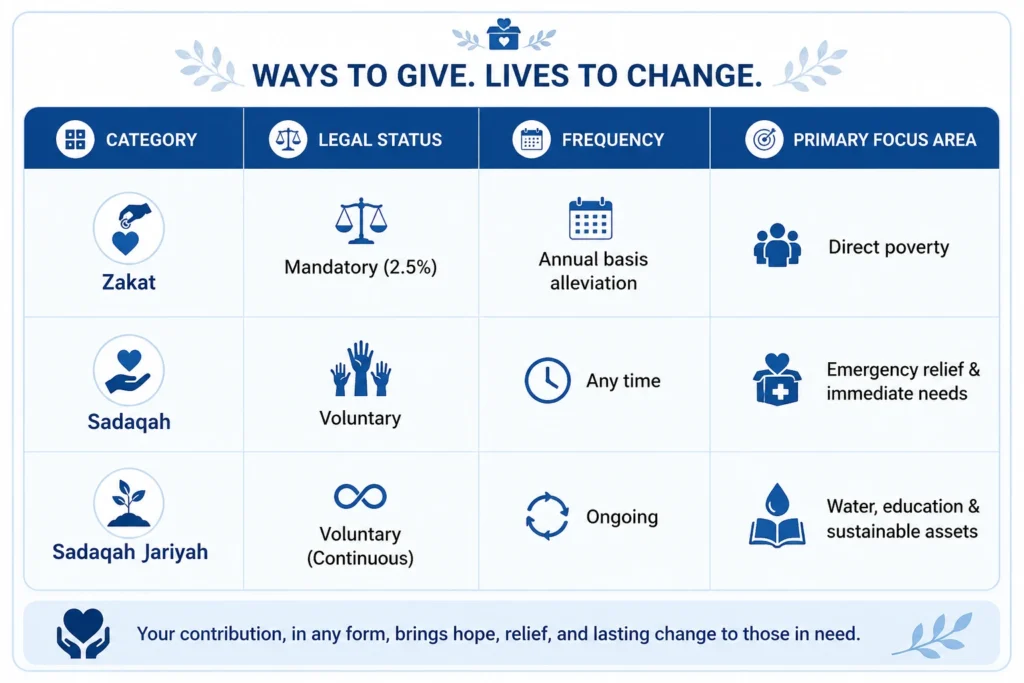
Beyond basic immediate aid, long-term continuous charity provides an enduring bridge of support for future generations. Investing in clean water wells, schools, or vocational trade kits creates a perpetual reward cycle for the donor while permanently lifting families out of poverty.
Zakat as an Economic Equalizer: Mandatory annual contributions calculated at two and a half percent serve as a powerful economic tool to prevent wealth hoarding. Directing these funds to eligible beneficiaries restores basic economic balance and protects vulnerable households.
Sadaqah as Daily Generosity: Voluntary charity encompasses any act of kindness, whether providing a meal, sharing knowledge, or offering a smile. This flexible form of giving allows anyone, regardless of income level, to participate in uplifting others.
The Endless Impact of Sadaqah Jariyah: Continuous charity focuses on funding projects that yield long-term benefits, such as solar water pumps, schools, or healthcare facilities. As long as people benefit from the resource, the donor continues to receive spiritual blessings.
Transforming Lives and Communities Across Pakistan
Applying these sacred principles in real-world settings transforms fragile communities into self-reliant hubs of activity. Traditional relief models often focus exclusively on emergency food distribution, which, while vital during disasters, does not solve generational poverty. Combining immediate relief with asset-based development fulfills the true spirit of faith-based charity by promoting financial independence.
When donors support Help in Need, our contributions fund holistic programs that protect family dignity. Providing a young adult with a trade kit or securing an orphan’s complete education creates a permanent shift in household income. This approach aligns directly with the core objective of faith-based giving: elevating individuals from aid recipients to self-sufficient givers.
Here are key benefits of applying faith-based giving to community development:
- Preservation of Human Dignity: Providing self-reliance tools allows families to earn halal livelihoods without relying on perpetual relief.
- Protection for Vulnerable Children: Comprehensive sponsorships cover education, healthcare, and emotional well-being for orphaned youth.
- Long-Term Community Resilience: Sustainable infrastructure, like clean water wells and solar pumps, improves public health permanently.
- Rapid Emergency Response: Flexible voluntary funds allow humanitarian teams to deploy instant aid during natural disasters.
Elevating Families Through Self-Reliance
Equipping adults with vocational skills and trade tools honors their personal dignity and capacity for hard work. Earning an independent income frees families from reliance on outside aid and breaks systemic poverty cycles.
Protecting the Rights of Orphans
Faith-based traditions place immense emphasis on protecting fatherless children and ensuring their holistic development. Comprehensive sponsorships provide high-quality education, healthcare, and emotional mentorship in a safe environment.
Building Sustainable Water Infrastructure
Access to clean drinking water remains a fundamental human right and a major pillar of continuous charity. Installing solar-powered water pumps eliminates waterborne diseases and saves rural women hours of exhausting daily travel.
Ensuring Transparency, Accountability, and Ethical Stewardship
For charitable donations to achieve maximum field impact, non-profit organizations must uphold the highest standards of operational transparency. Donors have a responsibility to verify that their contributions reach genuine beneficiaries through clear, accountable channels. Modern organizations utilize rigorous auditing, direct field tracking, and clear reporting to ensure every contribution is utilized effectively.
Ethical stewardship requires balancing immediate relief efforts with long-term strategic investments. Trusted organizations ensure that obligatory funds are distributed strictly according to established guidelines, while voluntary contributions fund broader development initiatives. Transparent operational practices build lasting trust between donors, field teams, and beneficiary communities alike.
Field teams conduct detailed community assessments to identify the most deserving households before distributing aid. Thorough verification guarantees that obligatory charity reaches eligible individuals directly. Moreover, maintaining open financial records and publishing regular impact reports ensures complete donor confidence. Independent audits verify that administrative overhead remains low and field delivery stays high. Furthermore, humanitarian work must always preserve the privacy, honor, and self-esteem of those receiving assistance. Ethical organizations avoid intrusive practices and focus on empowering individuals with utmost respect.
Practical Steps to Maximize Your Charitable Impact Today
Maximizing the effectiveness of your giving requires intentional planning, clear goals, and strategic choices. Rather than giving sporadically, establishing a structured charitable strategy ensures your contributions create continuous, measurable progress for families in need.
By aligning your financial planning with verified high-impact projects, you maximize both practical benefits and spiritual rewards. Every trade tool provided, student sponsored, or clean water source installed moves a community closer to permanent economic independence.
To put these principles into immediate practice, consider implementing these two actions right away:
1- Set up an automated monthly donation schedule to support ongoing orphan care or education programs. It ensures continuous support for growing students.
2- Allocate a portion of your annual giving toward long-term trade kits or solar water wells. Rather than short-term relief alone to create sadaqah jariyah pakistan opportunities.
Follow these practical guidelines to elevate your charitable giving:
- Calculate Obligations Accurately: Use precise wealth calculation tools to determine your mandatory annual contribution correctly.
- Prioritize Asset-Based Programs: Choose initiatives that provide tools, education, and vocational training to build long-term independence.
- Support 100% Donation Models: Partner with organizations that guarantee your full donation directly funds field operations and beneficiary assets.
- Involve Your Family in Giving: Teach young children the joy of generosity by selecting charitable projects and reviewing impact updates together.
Transform Your Faith into Life-Changing Action Today
FAQs
What is the core concept of donation in Islam?
The core concept views wealth as a divine trust that must be shared to purify one’s soul, reduce economic inequality, and protect human dignity across society.
What is the difference between Zakat and Sadaqah?
Zakat is a mandatory annual contribution calculated at 2.5% of eligible wealth, whereas Sadaqah is voluntary charity given at any time in any amount.
How does Sadaqah Jariyah benefit communities long-term?
Sadaqah Jariyah funds ongoing assets like water wells, schools, and vocational tools, providing continuous community benefits and ongoing spiritual rewards for the donor.