When most people think about donating to orphans, they picture food boxes or school bags being handed out at a big event. That image is not wrong — but it is incomplete.
At Help In Need (HIN), one of the most powerful things we do for orphaned children and their families is something far less visible: we put cash directly in their hands, every single quarter, without conditions.
No vouchers. No restrictions. Just real money for real needs.
This post pulls back the curtain on exactly how our Orphan Cash Grant Program works who qualifies, how much families receive, how we make sure the money reaches the right people, and what it actually changes in a child’s life.
If you have ever wondered whether your sponsorship truly makes a difference, this is your answer.
Why Cash? Why Not Food or Clothes?
This is the first question many donors ask — and it is a fair one.
In the early years of our orphan support work, HIN distributed in-kind support: food packs during Ramadan, winter clothes, school stationery. These things matter. We still do them through our Seasonal Interventions and Orphan Care Program.
But over time, we noticed something. A family in Rawalpindi and a family in a mountain village in Azad Kashmir do not have the same needs. The mother in Rawalpindi may need to pay a school fee. The grandmother raising her late son’s children in Bagh may need medicine. The family in Islamabad may need to fix a broken water pump.
A food pack does not solve any of those problems.
Cash does.
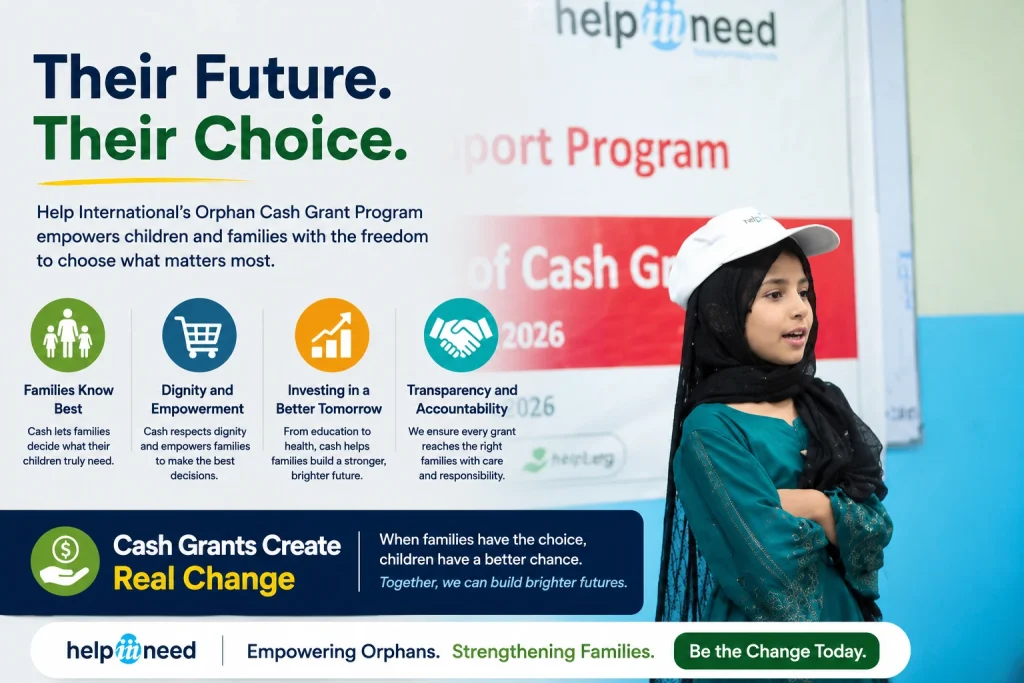
Research across the humanitarian sector — including work by organisations like UNICEF and CARE, both partners of HIN — consistently shows that cash transfers give families dignity and choice. They spend the money on what they actually need, not what someone else decided they need.
That is why our cash grant program exists.
Who Qualifies for a Cash Grant?
Not every family that applies receives a grant. Our field teams follow a clear eligibility process before anyone receives a single rupee.
1. The child must be a verified orphan
We define an orphan as a child who has lost one or both parents. Pakistan has a significant population of paternal orphans — children whose father has died, leaving the mother as the sole breadwinner with no income or very limited income. These children are often invisible to larger aid systems. HIN specifically works to reach them.
You can read more about this in our post on Orphan Care Programs in Pakistan and our broader Supporting Orphans in Pakistan work.
2. The household must be below the poverty line
Our teams conduct a household assessment that looks at:
- Monthly income (or absence of it)
- Number of dependents in the home
- Housing conditions
- Access to education and healthcare
- Whether the child is enrolled in school
Families with any stable income source above a defined threshold are not included in the cash grant cycle. Priority goes to the most vulnerable.
3. The family must be reachable and verifiable
We only enrol families in areas where our field teams operate and can conduct follow-up visits. This matters for accountability — more on that shortly.
How Much Do Families Receive?
The grant amount is calculated based on the number of orphaned children in the household and the overall vulnerability score from the initial assessment.
While exact figures are adjusted periodically based on inflation and funding availability, our cash grants are designed to cover at minimum one essential monthly need per cycle — whether that is school fees, medicine, a utility bill, or food for a week.
Grants are distributed quarterly, meaning families receive support four times a year. This is intentional. It creates a rhythm of reliability without creating full dependency. Between grants, our case workers check in to see how families are managing and whether they need to be connected to any of HIN’s other programs — such as our WASH and Primary Health Care initiatives or our Poverty Alleviation and Human Development work in education.
The Distribution Events: What Actually Happens
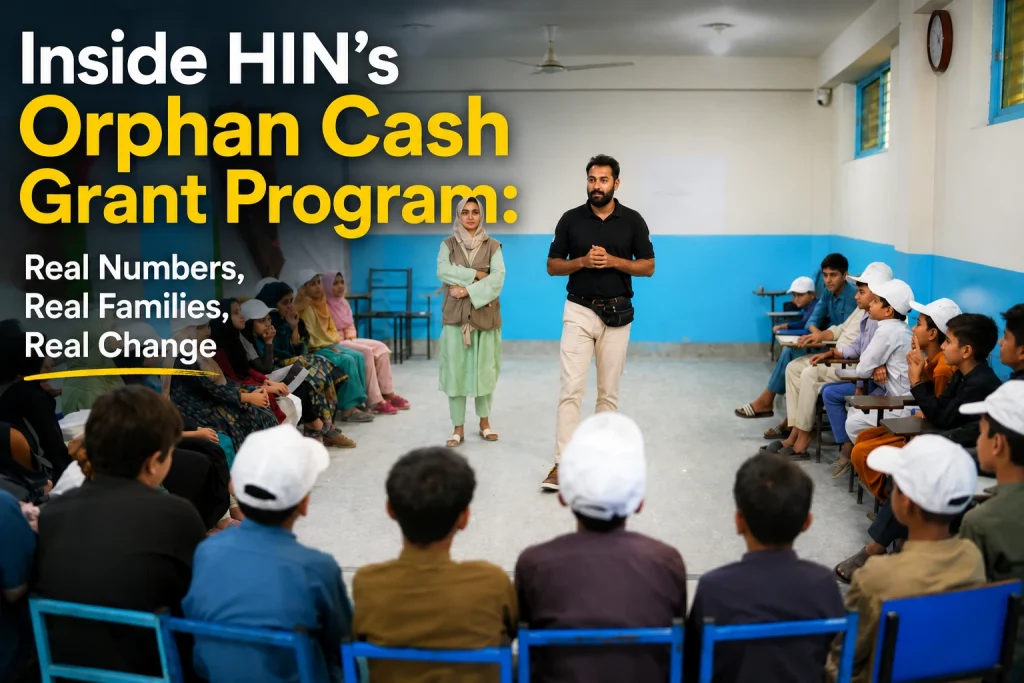
Twice this year in Rawalpindi and Islamabad — HIN held Quarterly Cash Grant Events that many of you may have seen on our blog.
In Rawalpindi, families gathered at a designated venue. Each family had been pre-registered. Their identity was verified on the day. Cash was counted in front of them, handed over, and recorded — by name, by amount, by date.
In Islamabad, the same process unfolded. Mothers, grandmothers, and older siblings came forward to receive grants on behalf of the children in their care.
What struck many of our team members at both events was not the moment of handing over the envelope. It was what happened just after — the quiet exhale. The small nod. The way a woman would tuck the envelope carefully into her bag and stand a little straighter before walking out.
That is dignity. That is what cash does that a food box cannot.
What Does PKR X Actually Buy?
Numbers without context mean nothing. So let us be specific about what a cash grant can do for a family in Pakistan today.
A typical quarterly grant, depending on the household size, can cover:
- School fees for one child for an entire term at a government school (where fees apply)
- Essential medicines for a month — particularly important for elderly caregivers managing chronic illness
- Utility bills — electricity or gas — that families often cannot pay, putting them at risk of disconnection in summer heat or winter cold
- Food supplements for a month for a young child who is nutritionally at risk
- Transport costs for a mother to attend a vocational training session through our Human Development programme
None of these are luxuries. All of them are things a family without income simply cannot manage on their own.
By the Numbers: The Programme So Far
Since HIN began its orphan support work, the scale has grown steadily:
- 15,392 children have been supported across our orphan programmes
- 1,000 orphans are currently sponsored on a regular basis
- Cash grant events have been held in Islamabad and Rawalpindi this quarter alone, with more cities planned
These numbers sit within our broader orphan and seasonal interventions work. For the full picture, visit our Seasonal Interventions and Orphan Care Program page.
What Happens Between Grants?
A cash grant every three months is meaningful — but a child’s needs do not pause between quarters.
That is why our case workers maintain ongoing contact with enrolled families. If a child drops out of school, we try to understand why and connect the family with our education support. If a family member falls ill, we can link them to our healthcare outreach. If a mother wants to learn a skill, we refer her to vocational training.
The cash grant is the entry point. The relationship is the programme.
This is what separates HIN’s approach from a one-time handout. We are not trying to be a charity that appears at Eid and disappears in January. We are trying to build something more lasting — a safety net that holds, quarter after quarter.
You can see this philosophy reflected in everything from our Humanitarian Relief work to our Community Empowerment programmes.
How You Can Be Part of This
Sponsoring an orphan through HIN is one of the most direct, accountable forms of giving available in Pakistan today.
Your donation does not go into a general fund and disappear. It goes into the cash grant programme, tracked, verified, and delivered — in an envelope, to a real family, in a real city, on a real day.
If you want to sponsor a child, make a one-time donation, or set up a monthly contribution, visit our Ways to Donate page. You can also reach our team directly at info@helpinneed.org or call +92 51 8732605.
And if you would like to support our upcoming Eid ul Adha appeal — where Qurbani meat will be distributed alongside our quarterly grants — visit our Qurbani 2026 Donation page.
Final Thought
There is a child somewhere in Rawalpindi right now who is going to school because someone decided to donate. There is a grandmother in Islamabad who paid her electricity bill this month because of a quarterly cash grant. There is a mother in Bagh who has a plan — because HIN gave her the resources to make one.
None of this makes the news. None of it shows up in a viral video. But it is real, it is documented, and it happens because people like you choose to give through an organisation that takes accountability seriously.
That is what the Orphan Cash Grant Programme is. And that is why it matters.
Help In Need (HIN) is a non-profit organisation registered with SECP (Reg. No. 0065549) and certified by the Pakistan Centre for Philanthropy. HIN has been serving deprived communities across Pakistan since 2003, with a focus on disaster resilience, education, WASH, and orphan care.
📍 Head Office: Fazal Software Technology Park, Plot 395-96, I-9/3, Islamabad 📞 +92 51 8732605 | 📧 info@helpinneed.org