Ask most people what a family in rural Pakistan needs to rebuild their income. And beekeeping probably isn’t the first answer that comes to mind. Yet this beekeeping livelihood project Pakistan initiative, led by Help in Need, is proving that a few wooden hives and a swarm of bees can do more for a household’s future than many larger interventions ever could. It’s quiet work, done mostly outdoors, away from headlines, but its impact reaches further than most people expect.
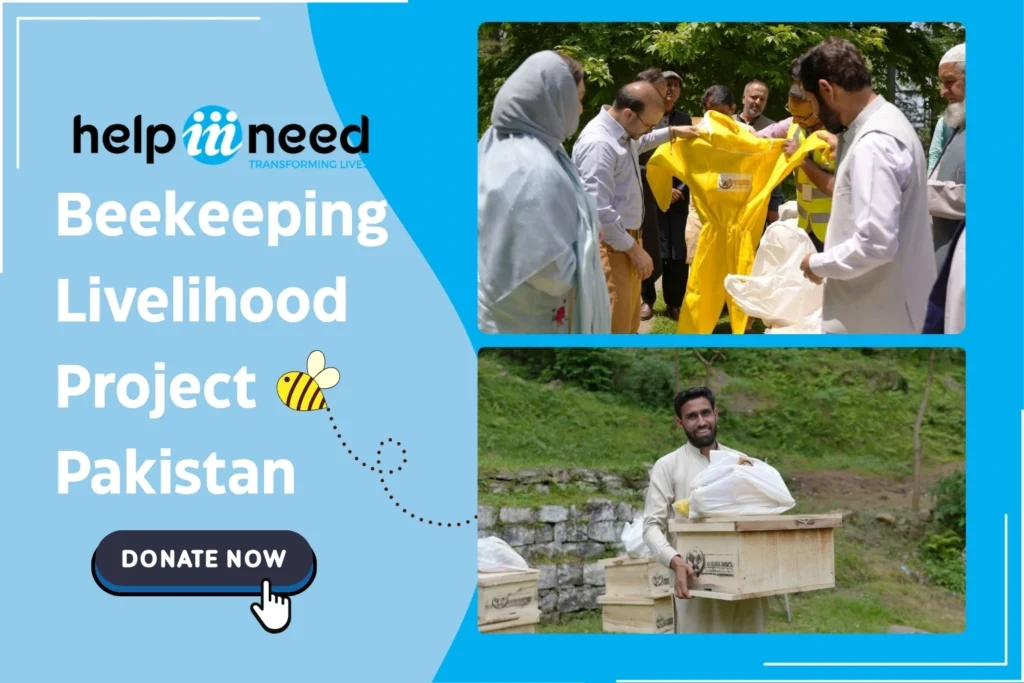
Help in Need recently organised a Honey Bee Kit Distribution Program to support individuals interested in beekeeping as a sustainable source of income. Team members and volunteers distributed fully equipped hive kits directly to beneficiaries. Many of whom had never considered beekeeping as a livelihood option before. What started as a modest distribution effort quickly became a demonstration of how simple, well-targeted support can open entirely new economic paths. for families who need them most.
What Is the Beekeeping Livelihood Project in Pakistan?
At its core, this programme is about giving people the tools and training to start their own honey bee farming business. Each kit typically includes a hive box, frames, a starter colony, protective gear, and basic beekeeping tools. Everything a beginner needs to get started safely.
Beekeeping, or apiculture, is the practice of maintaining bee colonies to produce honey, beeswax, and other hive products. It also plays a quiet but essential role in pollination, which supports crop yields for surrounding farmland. In Islamic tradition, the honeybee holds a particularly meaningful place. An entire chapter of the Qur’an, Surah An-Nahl (“The Bee”), references the bee’s role in producing. “A drink of varying colours, in which there is healing for people” (Qur’an 16:69). For many beneficiaries, this spiritual dimension adds another layer of meaning to the work.
For Help in Need, the beekeeping livelihood project Pakistan programme reflects a broader shift in how the organisation approaches poverty relief. Moving from short-term aid towards skills-based, income-generating support that beneficiaries can sustain long after the initial distribution ends.
How Does the Honey Bee Kit Distribution Program Work?
Distributing a beehive isn’t as simple as handing over a box. Help in Need’s approach follows a structured process. designed to set beneficiaries up for genuine, lasting success rather than a one-off gesture.
- Identifying suitable beneficiaries — individuals or families with access to land, interest in beekeeping, and a genuine need for a new income source are prioritised
- Providing full starter kits — each beneficiary receives a hive, an active bee colony, protective clothing, and basic extraction tools
- Delivering practical training — volunteers and team members guide new beekeepers through hive placement, seasonal care, and honey harvesting basics
- Following up over time — Help in Need checks in with beneficiaries to see how their hives are performing and whether further support is needed
This isn’t a programme built around large numbers or quick photo opportunities. It’s built around individual families, each starting a small business with real potential to grow. You can see how this fits alongside our other work on the livelihood support programmes, where beekeeping sits next to grocery stores, tailoring setups, and other income-generating projects.
Why Does Beekeeping Make Sense as a Livelihood Option in Pakistan?
There’s a community-wide ripple effect. When one household starts producing honey successfully, neighbours often take notice. And interest in beekeeping tends to spread organically through a village. This is part of why a beekeeping livelihood project Pakistan communities engage with tends to grow beyond its initial beneficiaries over time, With early adopters sometimes becoming informal mentors to others nearby.
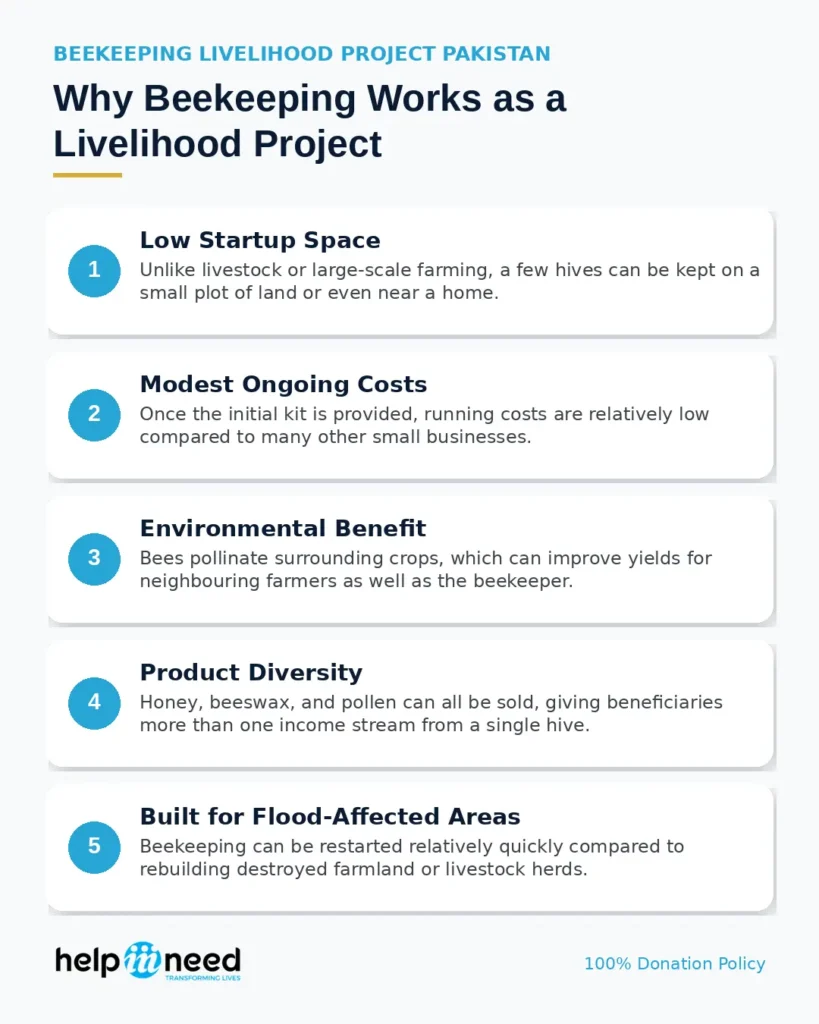
Rural markets across Pakistan also show consistent demand for locally produced honey. which gives beneficiaries a realistic route to selling their product without needing to travel far or rely on complex supply chains. Compared to crops that depend heavily on irrigation, fertile soil, or expensive machinery. A hive requires comparatively little beyond patience, basic maintenance, and a safe location to place it. For families recovering from flood damage or economic setbacks, that lower barrier to entry can be the difference between starting again quickly and waiting years to rebuild.
Bee farming also fits naturally alongside other small-scale agricultural work many rural households already do. A family growing vegetables or keeping a small number of livestock can add hives without competing for the same land or labour. Effectively diversifying their income rather than replacing one activity with another. This layered approach to livelihood building is often more resilient than relying on a single source of income. Particularly in regions where flooding or unpredictable weather can disrupt farming in any given year.
Who Benefits From the Honey Bee Kit Distribution Program?
Beneficiaries of this programme tend to share a few common circumstances. Many are from families affected by flooding, economic hardship, or the loss of a previous income source. Others are simply individuals in rural areas with limited access to formal employment. But a genuine interest in agricultural or environmental work.
For these families, a hive kit represents more than honey. It represents:
- A source of income that doesn’t require relocating away from home or family
- A skill that can be passed down to children or shared within the household
- A way to contribute to the local environment while earning a living
- A sense of purpose and self-reliance that short-term aid alone cannot provide
Volunteers who took part in the distribution described seeing real enthusiasm among beneficiaries. Many asked detailed questions about hive maintenance and honey extraction well beyond what was strictly necessary, a sign of genuine investment in making the venture work. That kind of engagement matters. Livelihood projects succeed not because of the equipment alone, but because of the commitment of the people receiving it.
What Challenges Do New Beekeepers Face, and How Is Support Structured Around Them?
Starting any new venture comes with a learning curve, and beekeeping is no exception. New beekeepers often face uncertainty around seasonal hive management, protecting colonies from disease, and timing their first honey harvest correctly. Weather patterns, particularly heavy monsoon rain, can also affect hive health if beekeepers aren’t prepared for it.
Help in Need’s programme addresses these challenges directly rather than leaving beneficiaries to figure things out alone. Training sessions cover the basics of colony health, and volunteers remain a point of contact for beneficiaries who run into difficulties after the initial distribution. This ongoing relationship is part of what separates a genuine livelihood programme from a simple donation drop-off.
Financial uncertainty is another common concern for new beekeepers, particularly around how and where to sell their first honey harvest. Encouraging beneficiaries to connect with local markets, or in some cases with each other to share transport and selling costs, has proven a practical way to ease this transition. Over time, manybeneficiaries build informal networks with fellow beekeepers in their area. Which strengthens the resilience of the entire local beekeeping community rather than leaving each household to manage in isolation.
What Is Help in Need’s Long-Term Vision for Beekeeping in Pakistan?
A single distribution day is only the starting point. Help in Need sees this beekeeping livelihood project Pakistan initiative as part of a longer-term strategy rather than a standalone activity, with plans to expand the number of hive kits distributed each season and deepen the training support available to existing beneficiaries.
Part of that vision involves connecting beekeepers with one another, so that knowledge, equipment, and even honey buyers can be shared across a wider network. Rather than staying isolated within individual households. Early feedback from volunteers suggests that beneficiaries who stay in contact with nearby beekeepers tend to manage seasonal challenges more confidently. Simply because they have someone nearby to ask when questions arise.
There’s also an environmental ambition behind this growth. As more hives are placed across flood-affected and rural regions, the cumulative pollination benefit for local agriculture increases too. Supporting not just beekeepers themselves but neighbouring farmers growing fruit, vegetables, and other pollinator-dependent crops. In this sense, every new hive kit distributed serves two purposes at once: building an individual family’s income, and quietly strengthening the agricultural health of the wider community around them.
For Help in Need, that dual impact is exactly why beekeeping earned its place alongside grocery stores. Tailoring setups, and other livelihood interventions the organisation supports. It asks relatively little in resources, yet gives back a great deal. both to the family holding the hive and to everyone whose crops benefit from the bees inside it.
How Help in Need Can Support This Work
Help in Need operates on a 100% donation policy. Meaning every contribution towards this programme goes directly towards hive kits, training, and beneficiary support, not administrative overheads. When you support the beekeeping livelihood project Pakistan initiative, you’re not just funding equipment. You’re funding a family’s ability to build an independent, sustainable income that can support them for years.
Whether it’s a single hive kit for one household or a wider distribution across a village. every contribution moves a family closer to genuine self-reliance. Visit our donation page to support the next beneficiary waiting to start their own beekeeping journey. or explore our other livelihood project initiatives to see how this work fits into Help in Need’s broader approach to sustainable poverty relief.
FAQs
What is included in a honey bee kit from Help in Need?
Each kit typically includes a hive box, frames, a starter bee colony, protective beekeeping gear, and basic tools for honey extraction. Beneficiaries also receive practical training on hive care and seasonal maintenance to help them get started safely.
Who is eligible for the beekeeping livelihood project in Pakistan?
Priority is given to individuals and families affected by flooding, economic hardship, or loss of income, who have access to land and a genuine interest in beekeeping. Rural communities with limited access to formal employment are particularly well suited to this programme.
How does beekeeping help the environment as well as beneficiaries?
Bees play an essential role in pollinating crops, which can improve agricultural yields for the wider community. This means beekeeping livelihood projects support both individual income and local environmental health. benefiting neighbouring farmland alongside the beneficiary’s own hives.
How long does it take to see income from a beehive kit?
Most new beekeepers begin producing harvestable honey within one growing season. Though this varies depending on colony strength, local climate, and seasonal timing. Ongoing support from Help in Need helps beneficiaries manage this timeline realistically.
How can I support Help in Need’s beekeeping programme?
You can donate directly towards hive kits and training through Help in Need’s donation page. Because of the organisation’s 100% donation policy, your full contribution goes towards equipping beneficiaries rather than covering administrative costs.
Help Grow the Next Generation of Beekeepers
A single hive can change a family’s future — and a beekeeping livelihood project Pakistan communities have welcomed with real enthusiasm shows just how far that change can spread. From individual households finding a new source of income to entire villages benefiting from healthier crops and stronger pollination, this is livelihood support with impact that lasts well beyond the first harvest. Help in Need ensures 100% of your donation reaches beneficiaries directly, with nothing lost to overheads along the way. Donate today at helpinneed.org and help a family build a future they can sustain themselves.